Asakusa Sensooji Temple Festival . Shinjuku (Kabuki-cho, Ni Ran) . Roppongi (Fusion Club, GasPanic, Fight, 64 Noodle House, Hideout Bar)
SaturdayMay 18, 2002
The hotel bathroom is puny. A sink, toilet, and shower all within a 5'x5' area. There is a soap, shampoo, and conditioner dispenser against the wall next to the sink and shower. Space is a major commodity in Tokyo, so cleanliness and efficiency are a must. The suds smell nice, like citrus. While we are on the subject of bathrooms, I've seen ads for multifunctional toilets that have a seat lift feature to lift senior citizens off from a seated position after their bowel movements. I've even heard of toilets equipped with flush-noise buttons to discreetly disguise any embarrassing flatulence.
After our showers, we take the subway to Asakusa. Most of Tokyo is surrounded by a circular rail, the Yamanote line. It takes an hour to make one revolution. Akasaka (the neighborhood where we're staying) is within the circle in the southwest quadrant, at about 8 o'clock. Asakusa is at 2 o'clock just outside the circle. When I'm navigating, I always have several maps of different scales visualized and rotating around in my head. I switch between the large-scale clock map and the neighborhood map of each subway and train station with relative ease. I rarely get lost during the daytime, unless I'm not paying attention or the sky is uniformly overcast or raining. It's easy to get around in Tokyo, though, since there are many signs and their public transport system is so intuitive.
There's supposed to be an annual festival at the Sensooji Temple this weekend called the Sanja Matsuri, something not to be missed. We figure it's a good way to get culture and photographs during the daytime, while nights are spent in hedonia. As we ride across town, the subway gradually fills up with festival-goers. Asakusa station has many exits, but only one is lined with paper lanterns and matsuri paraphernalia. We head that way.
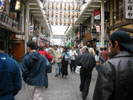 Outside the station is an old section of Tokyo. There is a covered galleria section with a brick walkway lined with numerous quaint-looking shops: that's where we're headed. The temple is on the far side of the galleria. We pass by shops selling Japanese-style foods and sweets, cheap clothing, and other trinkets. There is a guy demonstrating a cheap toy, a small paper clown with rubber legs and foam feet. It's called a Magic Johnnie, and it stands 5 inches tall. It appears to be dancing to his command on the street. The guy says "jump", and it jumps. It stands up even though it's clearly not stable enough to do so. Ants, Quoc, and I are pretty stupefied. How does that thing work?! I was conjuring up some half-baked theory involving magnets. Quoc buys one just to see... it turns out there's a transparent string connected to it that the guy was tugging at. The string is practically invisible, none of us saw it. We're somewhat unimpressed now. Quoc plans to give the Johnnie to his nephew.
We pass by a McDonald's and certain memories come flooding back. Seven years ago, I was here with Tal Margalith, a college classmate. We both bought noren (doorway curtains) and got milkshakes at the very same McDonald's. It's funny, but Tokyo puts my sensory mind in overdrive. I don't think I'm as awake anywhere else other than Tokyo. I can remember in exact detail about my time there seven years ago, while from that point on, it's all a blur. That's how I can write in this level of detail almost two months after it happened. If I lived in Tokyo, my subjective sense of time passage may extend long enough for several lifetimes. I wish I could say the same about the States; I'm sleeping through my life there.
We duck into a cozy noodle house for lunch. Japanese food is too light and minimal for Ants' taste, who has a feeling he will lose weight during this trip. Ants wants some water, so I try to teach him how to ask for it in Japanese. "Mizu, sampon kudasai," I say. He repeats, "Mizu, sampon kuda-wha?" He gets it after a little practice, and then I throw in a complication... "If you want to say it the ultra-polite way, you've gotta say, O-mizu instead of mizu." This upsets the little he's already learned, and he starts giggling. The waitress comes by and he says, "Uh, mizu." It does the job.
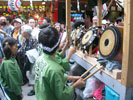 As we're eating, the sound of drums and chanting are approaching. Through the small doorway, we spy a large troop of Japanese in happi coats with headbands, groinbands, and white toe-sock shoes toting a large omikoshi (portable shrine) on their shoulders. The shrines have ornate black laquered frames with gold trim and thick purple ropes, and they look very heavy. They are preceded by religious-looking men in robes and headdresses, beating a drum. The ones lifting the shrine shout "SEIYA!" and make a single step to each beat of the drum. The shrine is constantly bobbing up and down in a rhythmic fashion. Their cohesiveness and emphasis on the group makes me envision a collective hive-mind; I recall a Japanese proverb that goes, The protruding nail will be hammered down. Unconsciously I glimpse a unified Japanese mentality capable of justify fervorous extremes such as war and kamikaze. On the brighter side, their post-war exponential economic growth probably originated from the same spark. Whatever they do, they go all out.
We leave the noodle house after our meal to get a closer look. Outside, the crowds are pushed to the sides of the street to make way for the shrine-bearers. Aside from the groinbands, the guys are naked waist-down.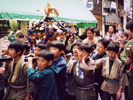 Some portable shrines have wheels and are pulled / pushed. Inside several people are seated, usually children dressed in a traditional manner. In addition to priest-like men, some of the shrines are preceeded by women who resemble geisha. They wear heavy white makeup, lipstick, and a headdress. The nape of their necks are bare, without makeup; apparently that was very attractive to the Japanese men of long ago. They also wear geta, or wooden clogs. As we wind our way through the crowd towards the temple, we pass about a half dozen portable shrine processions. There are even mini-shrines toted by children. It's like a very crowded parade. The shrine bearers are so close, you can smell their perspiration and the stench of alcohol on their breaths. Occasionally, they lose control of the heavy shrine and they start to bowl into the crowd, but they quickly regain control. I hear it's not uncommon during these events for an occasional freak accident to occur, with someone ending up squished.
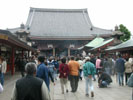 After 20 minutes of persistent pushing and shoving, we make it to the temple. Suspended beneath the large gate are three enormous paper lanterns bearing the Chinese characters which name the temple. I think it means "thunder". The middle lantern has been retracted halfway up to make room for the shrines to pass through; they steadily emanate from the central gate to parade around the old district. We walk through the gate to view the inner courtyard. The main temple is straight ahead. It is flanked and preceded by numerous smaller wooden structures, housing temple workers selling omikuji, or paper fortunes. You're supposed to buy these things for 100¥, then tie them to a net of thin ropes strung horizontally between two wooden poles. They sort of predict your luck for the upcoming year. They also sell trinkets, shinto objects of worship, etc. There is a large smoking pot in the middle of the courtyard where people place burning incense. People are standing about it, waving the smoke to cover their heads. I'm not sure of the significance of that one, but like the tourists we are, we wave the smoke around our heads too.
We climb up the stairs to the inner temple and take a peek inside. There's an inner area behind screens housing various religious artifacts. A big wooden box-like structure is placed immediately in front of the screens. There are bars with narrow slats fixed across the top of it. People throw coins into the box, clap their hands twice together, and pray with their head bowed down. I throw in some 10¥ coins and pray too. It reminds me of when I used to pray to Santa Claus to get certain gifts for Christmas, only Santa didn't charge anything. I guess I got what I paid for.
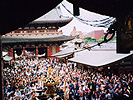 We turn around to look down at the temple grounds from the inner temple. There's a mob of people on the steps, and now the parade has begun to traverse the area immediately below. We exit the side of the temple and make our way into the gardens. I remember being here, taking a picture that eventually wound up in my senior year Caltech yearbook (1996). I take a picture in the exact same spot, on a stone bridge spanning a small brook filled with koi (carp). We head further along and encounter a small area filled with stalls selling traditional foods such as taco (octopus), okonimiyaki (japanese omelette pancakes), and flavored icees. I buy one of the icees and flavor it with melon and strawberry. The end result is a peculiarly sweet, brownish slushy.
We leave the temple area, amazed at the spectacle. Near Asakusa station, we duck briefly into a large department store to look at their wares, but quickly get bored and head home via subway. I felt pretty exhausted from the crowds and noise.
That evening, we decide to head to Shinjuku for dinner. Shinjuku is one of the major financial centers of Tokyo, and its station fluxes over a million people a day. Many of the tallest buildings in Tokyo are there; seven years ago I remember going up on the observation deck of the twin tower building. The tallest building in Tokyo is in Ikebukuro, I believe, and the tallest building in Japan is the Landmark Tower in Yokohama. Near Shinjuku is Kabuki-cho, an entertainment area famous for its red-light district; despite the name, there is a distinct lack of kabuki theaters.
We arrive at night, and the station is still bustling, though not as busy as I could imagine. The sky has darkened outside. There are crowds and neon lights everywhere, even brighter than the Shibuya area. We head where the crowd is going and wind up in a particularly active area of nightlife. We're hungry so we're on the lookout for cheap noodle bars and the like. Even better, we spy a [Yoshinoya], and we head in to get a beef bowl. They have a special on them; each one is 250¥. There is an extensive menu on the wall, but I can't read it. All I know how to do is say "Gyuudon," or beef-bowl. Then the guy taking our order blabbers something at us, and I look puzzled. He realizes that we are foreigners, and pulls out the picture menu. I realize that he's asking about the size of the beef bowl; I pick the regular one. Quoc and Ants have the same. Unlike the Yoshinoya's back in SoCal, there are no teriyaki chicken bowls, but there are various odd items like pickled vegetables, raw eggs, etc.
After we eat, we wander around a bit. We wander under a colorful neon arch into a maze of brightly lit small streets. I have a feeling we've wandered into Kabuki-cho because every five steps, we're approached by some guy in a black suit. They come in two flavors: Asian and African. If they're Asian, they yell at us in rapid unintelligible Japanese. If they're African, they say "Live show, live show." Either way, we have a strong idea about what they want. We're a big target for them because we're a trio of asian young men. They come on so strongly that at times we have to be downright rude to get some of these guys off of our backs.
One guy, a short, thin asian with closely cropped slick hair and a goatee, is walking alongside us chattering away. At this point our tolerance hasn't yet disintegrated, so we politely make a sign that we don't understand him. He switches languages. "Are you Korean?" "No." "Chinese?" "Yes, but we speak only English." He starts speaking in broken English. "Live show! You like Japanese girls? Korean girls? Thai girls?" "What do you mean, what is this all about?" I ask, just to see. "Massage. You like blowjob?" He gestures, moving a fist toward his face and a tongue protruding in his cheek. "No thanks, man," I say, and we're all kinda busting up laughing because of his body language. We let him down, and in the end he gives us his business card. I inspect it. His name is Ni Ran, and he is from mainland China. His job in Japan is to lure men into sex shops where they can empty their pockets. "Give me a call and I can fix you up if you're interested." We walk down further, and another guy in a suit starts accosting us. "No thanks," we say, and hurry along. He yells out after us, "Handjob wa ikaga desu ka?"
A little further along, we pass by a well-dressed Japanese woman lying on the ground next to a pool of her vomit. She's holding her hand against her mouth in embarrassment. I have a pocket full of tissues, and for a moment my old chivalrous instincts make me think about giving it to her. But then I figure that she got herself in that situation to start with, now she has to deal with it. If I were younger, and maybe if I hadn't done medicine as a career, I might have given in to those instincts. But currently I'm at the height of my bitterness.
We sit up against a rail for a minute on the sidewalk. Kabuki-cho is excessive in its entertainment, and we were so busy fending off the suits that haven't had any opportunity to explore Shinjuku at all. We decide to head back to Roppongi for some cleaner fun. We arrive at the crossing later on in the evening, and it is even more crowded than last night. There are still men in suits here, but they're not peddling sex... at least not the hardcore kind. An African guy hears us speaking English and he begins his hard sell. He says there's a club that we might be interested in, a gentlemen's club. "Why won't you check it out? Just see it," he pleads. He tries so hard that we feel bad turning him down, and we think what the hell, it's harmless to just take a look. He leads us through a couple of back alleys on the way to the club. We all chit-chat along the way. Apparently he's from Nigeria; I wonder how he wound up in Japan. We reach the club entrance; it is called [Fusion]. The club facade is lit up against the drab alleyway. A set of stairs lead down from the street level towards the entrace. There is a small crowd of Japanese businessmen congregated out front, bowing and talking to a suited man who appeared to be a club host. Presumably, they had a good time in the club and they were being gracious.
We walk in, and it looks clinical; there are glowing panels on the walls and floors lighting the way. A couple of female receptionists at the front desk take our coats and umbrellas. We round the corner and behold a dimly lit swanky seating area with plush couches, in which are seated a bunch of Japanese businessmen. There is a stage in front where a stripper is performing her dance, and a large bluish tank behind us where a buxom woman in a g-string swimsuit is swimming around with goggles and an oxygen hose attached to her face. We all thought that was pretty far out. Most of the women are caucasian. A British or Australian man comes up to us and yells at us in Japanese, "Irasshaimase!" He says more, probably to the effect of welcoming us to the club, showing us towards our seats, asking us what we'd like to drink, etc. He soon figures out that we speak English. We are not too keen on staying in a place like this, so we express our doubts and start heading to the door. The Brit says, "We're having a special tonight, I'll give you guys a round of drinks on the house, and knock down admission price to 4500¥ each." We say no again, and thank them for showing us around. He makes one last sales pitch, "I can guarantee you that if you look around, there are no other clubs like this in Roppongi. There are no girls like ours..." In the end we leave, and I figure we won't humor anyone again to just "check out" the club, because it was more awkward entering and then leaving, rather than if we were rude to the Nigerian in the first place and just said "no".
On the streets again, we walk down several alleyways to see what hidden clubs reside within the darker corridors of Roppongi. We see another [GasPanic]; this one is accessible via elevator only. We ride the elevator up and open into one of the most crowded clubs I've ever been in. There is standing room only, and it's hard to manuever amidst the squirming bodies. The music is identical to the last [GasPanic]. The club-goers are participating in pretty wild hijinks. Every once in a while, people are chosen at random by a bar worker to guzzle an entire bottle of beer via a funnel and plastic tubing. (I suppose this is common practice at frat parties, but not at Caltech, surprise surprise.) There are several women dancing on tables and on the bar. One of them is a caucasian girl, who by U.S. standards is not so pretty, but within the confines of a dark and deafening bar amidst drunken Japanese party people, she is a golden-haired goddess. She keeps shaking her rear end towards the crowd, and people keep swaying their hands towards it. There is another girl, a Japanese girl dressed up as an ultracute fairy, complete with white boots, white over-the-elbow gloves, white wings, and a white halo. She is litterally glowing in the blacklight. She is also dancing on the bar. The unabashedness of Japanese costume and uniform dress is something that will always escape me. After several drinks, we decide to go. It is simply way too crowded.
Outside the club, we encounter a rowdy group who appear to be from the U.S.; by their language and mannerisms I could swear they're african-american gangsters from the Bronx. We wonder what they're doing in Tokyo... military men on R&R, perhaps? Unfortunately, they're yelling out obscenities to each other, and this culminates in a pretty violent fist fight, leaving one person huddled on the ground while the others punch and kick him. We give them wide clearance, disappointed by the behavior of our country's young ambassadors.
The beef bowl wasn't enough, and we get hungry. We enter a trendy noodle house near the crossing for a late snack; it may have been called 64 Noodle House (or something with a number like 64); it's already past midnight now. I get the barbecue pork ramen, and it's a bit salty... but man, it was delicious! Quoc and Ants are getting tired of noodles. Afterwards, we head towards the bars again.
After checking out several more bars and clubs, we decide on one called Hideout Bar. It is a dark, cozy underground bar with a dance floor, packed with a young and relatively international crowd. The music is trance / techno and it is deafening. There is no cover and only a single drink minimum. One of the waitresses is a slightly plump Israeli female. She and I exchange a few pleasantries, but as the conversation gets more complex she gives me a puzzled look, makes a gesture to her ears, and yells, "I can't hear you!" She's been working here for a month, and with the music so loud, I'm sure she is suffering from high frequency hearing loss. Apparently from what she said, she hasn't gotten quite comfortable with Japan yet. She drifts through the crowd, smiling provocatively and occasionally dancing with the customers, but it's pretty clear that her ulterior motive is to get them to buy a drink and give her a tip. After some clumsy dancing, I relax on the side and chat (more like yell) with Ants. It's too hot to dance and I need to cool down. A guy asks me for a light, and I strike him one. We happen to be carrying matchbooks from our hotel, so in case we get separated or if one guy wants to go home early, each one will be able to show a cab driver the hotel and address rather than struggle with the language. Another guy notices and asks me for a light as well. I think to myself, 'Hey, it's your lungs, man...' but the secondhand smoke is killing me. The music is good, and as opposed to the [GasPanic], we don't hear the same music twice during the same night. We wind up staying late and leaving the bar at 5:30AM, and the sun is already up in a very bright blue sky. It feels as if there are thick pieces of cotton in my ears. People are still walking the streets in a daze. Quoc and Ants remark that the nightlife in Tokyo is extreme; there's nothing like this in the States except for after-after-hours raves, and everyone is high on E at those types of places. In contrast, I got the feeling that what we were doing was still considered relatively mainstream by the native Tokyoites. Going out like this will keep us from ever accomodating to the different time zone. We hike home to our hotel and collapse.
2002
Fri, 17.May
† Sat, 18.May †
Sun, 19.May
Mon, 20.May
Tue, 21.May
Wed, 22.May
Thu, 23.May

OTHER
DESTINATIONS
Japan 2004
Taiwan 2009