To Mt. Koya . Cable Car . Sekishoin Temple . Okunoin
SundayMay 09, 2004
In the morning, we went to Shinagawa station and took the Shinkansen (Hikari, or the intermediately fast one) to Osaka station. Khanh and Quoc had gotten an entire 2 hours of sleep, having danced the night away at the Roppongi GasPanic. 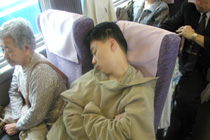 The ride took a couple of hours, and Quoc caught up on sleep on the silky smooth ride. From Osaka station, we took a 1.5 hour local rail to Mt. Koya. Along the way on several stops, we picked up loads of junior high school girls in uniform; they wore sports uniforms, and were either on the swim team or the badminton team. They all stared curiously at Jamie, the only caucasian on the train. She gave them a wave and a smile, and wide bashful grins broke across their faces. I supposed that away from the big cities, caucasians were more of a rare sight.
The train gradually emptied out as we neared our destination, until there were just two other people in our car aside from us. The train ride itself was beautiful, as we went up into the mountains. There were picturesque deep valleys covered in green, with little signs of human activity, indicated by a dwelling here and there. It felt like a ride in Disneyland. 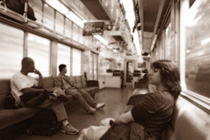 We had to stop along the way to let another train pass us heading the opposite way; it was far too rural to have dual lines. When we arrived at Mt. Koya, I noticed that the passengers who filed out were on the middle-aged to elderly side. I guess it's not too cool for young Japanese teenagers to visit remote Buddhist temples.
The platform we emptied onto led onto a 45-degree cable car platform. The cable car was also oriented at a 45-degree angle, so that it was like sitting on steps. We carried our luggage onto the train and sat down. As the cable car began creeping upward, what sounded like an old scratchy record came on, initially slowed and distorted but it quickly sped up to a normal speed. The music sounded as if it had been composed during the WWII era for a nature documentary, but it seemed somehow appropriate. A pleasant female voice told us in Japanese all about our Buddhist mountain destination. We rode up the mountain, passing small brooks, forests, and lots of greenery. It was so idyllic.
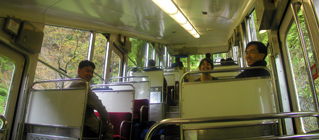
When we reached the station at the top, we paused to get some refreshments. Being a Buddhist town, the only things we could find were an-pans, mochi cakes filled with red beans, and other traditional snacks. It was a very different feel from the rest of Japan. I went to the bathroom, and emerged to find my friends. We took a bus into town, a bit unsure about the directions, but the bus driver reassured us that he would deposit us next to Sekishoin, the temple where we booked the night. We rode through town and it was packed with Buddhist temples. One right after the other. The sky was gray and rain was near, but we felt very excited about being here. At least, Jamie and I did... Khanh and Quoc may have preferred Roppongi.
We got off at our stop after a relatively short time on the bus, but we were located on the far side of town from the bus station. I recognized our temple from the pictures I saw on the internet. We headed through the gates and outer courtyard, and into the inner grounds. Two bald, gray-robed monks were standing near the entrance hallway looking at us. One of them spoke my name "Wong-san" questioningly, and I nodded and confirmed our reservation with them. He brightened up, and instructed us to come inside. We changed into slippers at the raised wooden entranceway and walked into the temple, and towards the guest quarters, passing along tatami-lined prayer rooms, dining rooms, and such.
The monk was sort of a mildly stocky, cheerful man. He showed us each of our rooms, traditional tatami rooms with futons piled in the corner, each with a view of the temple garden. It was pretty much what one would expect from a remote Japanese buddhist temple... amazing. A little TV in the corner and yet another high-tech toilet were the unusual things, however. We were all pretty impressed. The monk sat down in the room with us for a while. He inquired about where we were from and asked a bit about each of us. He took a particular joking interest in Khanh because of his bald head, saying that he looked like a typical Buddhist student coming to the town to study! This made us all laugh. He then gave us a breakdown of the schedule... morning prayer at 7AM, breakfast afterwards, and the local sights in the town. He asked us if we had seen the town yet, and how long we were planning on staying. I was the translator for our group. 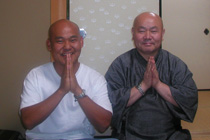 Only one day, I said, and no we haven't seen anything yet. At this he grew astonished, saying that there's not much more time, but you must at least see the grounds of one temple, they have beautiful flowers. He gave us some maps and told us how to get there, and we were grateful. Before we set out, we all took pictures with him, in monk poses. The guy was a really good sport.
Somehow during our time at the temple, probably at the current time, I asked him about why the Yoshinoyas were no longer serving beef bowls. You couldn't even see beef on the menu... only pork bowls. I was astonished when the words "BSE" came out of his mouth. I mean, not astonished because he knew the technical term (bovine spongiform encephalopathy) which was kinda impressive, but that a vegetarian monk at a remote Buddhist village would be so educated when our own citizens in the States can be so ignorant of this stuff.
We set out on the town, taking our umbrellas with us because of the impending rain. We rushed towards the recommended temple, adn it turned out to be not so trivial a hike despite the smallness of the town. It was up a small hill. When we got there, the courtyard was empty. There was an interesting-looking garden, but I didn't get the impression that it was a must-see... however I was glad to have seen it because the monk had been so enthusiastic in his recommendation. We took a few pictures. 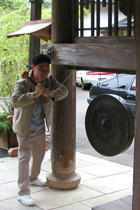 There was a gong at the entranceway with a big hammer attached to it, and Quoc posed as if he were going to smash it into the gong.
It started raining at that point. We were getting hungry so we wandered back down the hill to town, in search of some food on the main strip. Most places were actually closing, because of the rain. It was strange that it was such a quiet town, but then again that's part of the charm. We found a convenient store, and I made a mental note to come back here if we were hungry. Nearby was a chinese restaurant that we just decided to duck into because of the general unavailability of eating establishments. The only thing memorable about the food was that Khanh didn't like what he chose (some sort of rice dish with an egg-like protein jelly on top of it) and couldn't eat much of it. From the look on his face (one which literally shouted 'wtf?!') when the dish was placed in front of him, it clearly was not what he was expecting when he made the order.
By this time we went back to the hotel for a quick rest. Jamie was fascinated by the advanced toilet with auto-heated rim and bidet. You could press one button for washing the female genitalia, the other for the anus. We both tried it in turn and it forced some giggly squeals out from us. I recall back in 1995 when I was in Japan for the first time, seeing a commercial for a toilet with a toilet seat which automatically lifted old people into a standing position. We made our futons for the night, and Jamie crawled into one to test it out. The fat cushions reminded me of a large marshmallow.
We all decided to go out at night, to walk the cemetary path to the Okunioin mausoleum, which was situated just near our temple. The cemetary walk was supposed to be a kilometer, and I had read that it was a great experience at night to walk along the stone path between the tall trees and among the numerous gravestones. The road split into two and we took the left route towards the mausoleum. We tried to freak ourselves out by making ghost sounds at one point, but we're too old and skeptical for it to be anything but silly. The walk was incredibly atmospheric... a lonely, long path with thousands of gravestones dotting either side of the foresty hills beside the road. The torii (stone lanterns) emit a soft yellow-orange from regular intervals along the road. 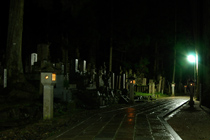 Off the side and above us is pitch black as the huge tree canopy drowns out any moonlight. Some of the stone buddhist statues off the side of the road are dressed up in caps and bibs, a phenomenon I had seen in Kamakura during my prior trip to Japan in 2002. Along the way, we pass a lone monk walking back towards the village.
Eventually we reach the mausoleum. There are several structures, lit by paper and stone lanterns. There is almost no one around. We wander around the temple buildings, and cross a wooden bridge towards the mausoleum. In the mausoleum structure we can see a monk praying. We circle several times, taking in the sights. I think I recall the rain starting to let up while we're here. Several torii are completely moss-covered... rain and moisture must be common occurrences here. At least, there seems to be a lot of fog atop the mountain. The place felt very spritual and peaceful, but it was hard to gauge because of the thickness of the night.
Eventually, we make our way back along the dark cemetary path, back towards the light of the temple village.
2004
Thu, 06.May
Fri, 07.May
Sat, 08.May
† Sun, 09.May †
Mon, 10.May
Tue, 11.May
Wed, 12.May
Thu, 13.May
Fri, 14.May
Sat, 15.May
Sun, 16.May

OTHER
DESTINATIONS
Tokyo 2002
Taiwan 2009